
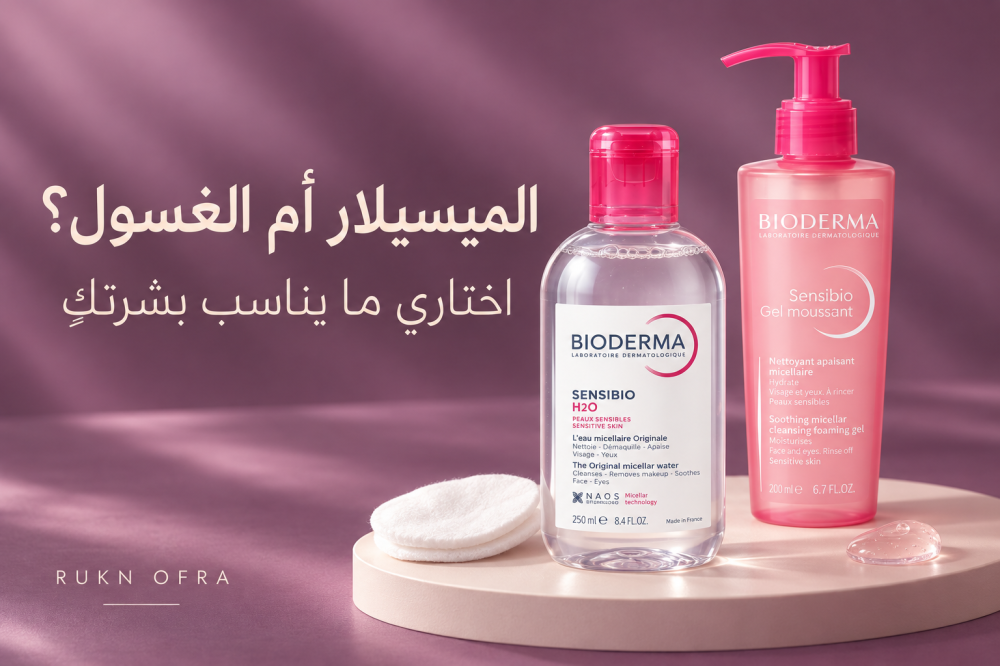
Micellar Water vs Face Wash: How to Choose the Right Cleanser for Your Skin
When browsing skincare products, you will find micellar water, face wash, and makeup removers. Do they all do the same thing? Can micellar water replace face wash, or should you use both?
The difference between micellar water and face wash comes down to their formulas, how you use them, and what they are designed to remove. Micellar water is usually applied with a cotton pad to cleanse the skin and remove makeup. A rinse-off face wash is generally applied to wet skin and washed off with water.
Their functions can overlap, so the right choice depends on the product’s directions, your skin type, and what you need to remove.
In this RUKN OFRA guide, we explain your options and help you build a cleansing routine without unnecessary steps.
What Is Micellar Water?
Micellar water is a cleanser containing tiny structures called micelles, which help capture makeup and impurities. It is usually applied by soaking a cotton pad and gently wiping the skin.
Some formulas are designed for use without rinsing. For example, BIODERMA Sensibio H2O is intended to cleanse the face and eyes and remove makeup without rinsing. However, one product’s instructions do not automatically apply to every micellar water.
What Is Face Wash?
Face wash covers several types of cleansing formulas, including gels, creams, and foams. Here, we are discussing rinse-off cleansers used with water.
Do not choose a face wash based only on how much foam it produces. What matters is choosing a suitable formula and using it gently. The American Academy of Dermatology recommends a gentle, non-abrasive cleanser, lukewarm water, and avoiding scrubbing.
The word “micellar” can also appear on a rinse-off cleanser, such as BIODERMA Sensibio Gel Moussant. Always read the directions instead of relying on the product name alone.
What Is the Difference Between Micellar Water and Face Wash?
FeatureMicellar WaterRinse-Off Face WashApplicationUsually applied with a cotton padUsually applied to wet skinRinsingDepends on the product; some formulas require no rinsingRinsed off with waterMakeup removalDepends on the formula and the makeup being removedSome face washes also remove makeupEye areaOnly if the product is intended for that areaFollow the product’s directionsHow to chooseConsider your skin, makeup, and the complete formulaConsider the formula and how comfortable your skin feels after washing
Micellar water is not always a compulsory first step, and face wash is not necessarily enough to replace every makeup remover. Choose according to what the product is actually designed to do.
Can Micellar Water Replace Face Wash?
There is no single answer for every product or routine. Some micellar waters are designed to cleanse without rinsing. You may need an additional cleansing step if makeup remains or the products you wear are difficult to remove.
BIODERMA states that Sensibio H2O and Sébium H2O do not require rinsing. This does not mean that using a face wash afterward is prohibited—or that everyone needs to add one.
Before adding another step, ask yourself:
- Is this cleanser suitable for removing the makeup I wear?
- Are there visible traces left after cleansing?
- Does my cleansing method leave my skin comfortable or irritated?
- Am I using several products because I need them, or because I am copying a lengthy routine?
The goal is to remove what is on your skin gently, rather than use as many cleansing steps as possible.
How to Choose Micellar Water and Face Wash for Your Skin Type
Sensitive Skin: Focus on the Formula and Gentle Application
If you are looking for a makeup remover for sensitive skin, explore BIODERMA Sensibio H2O Micellar Water, 250 ml.
BIODERMA positions it for sensitive skin and for cleansing the face and eyes without rinsing. Follow the directions and avoid repeatedly rubbing the skin with the cotton pad.
If you prefer cleansing with water, consider BIODERMA Sensibio Gel Moussant for Sensitive Skin, 200 ml. The brand describes it as an unfragranced, soap-free cleanser that is applied to wet skin and rinsed thoroughly.
These offer different cleansing methods. Having sensitive skin does not automatically mean you need to buy both.
Oily and Combination Skin: Choose Suitable Cleansing Without Overdoing It
If you are looking for micellar water for oily and combination skin, explore BIODERMA Sébium H2O Micellar Water, 250 ml.
The brand positions it for combination to oily skin and facial makeup removal. Its directions state that rinsing is not required. Do not assume it is intended for eye makeup: Sébium H2O’s directions specifically refer to the face.
For a rinse-off option, consider BIODERMA Sébium Gel Moussant Face Wash, 200 ml, which is designed for combination and oily skin, removing impurities and managing shine.
Having oily skin does not mean you need to scrub or wash repeatedly throughout the day. Gentle cleansing remains important.
Dry Skin: Prioritize Comfort After Cleansing
Do not select a product simply because it is called a “water” or “gel.” Check whether it suits dry skin, and avoid treating a strong feeling of tightness as proof of effective cleansing.
If your skin is dry, follow your routine with a suitable moisturizer. The American Academy of Dermatology recommends moisturizing when skin feels dry or itchy.
How to Use Micellar Water
- Read the product’s directions, especially instructions about rinsing and the eye area.
- Soak a cotton pad with an appropriate amount.
- Gently wipe the areas the product is intended for.
- Follow its directions regarding repeated application or rinsing.
Sensibio H2O’s directions include the face and eyes, while Sébium H2O’s directions specify the face. This distinction matters when choosing a makeup remover.
How to Use Face Wash
Wet your face with lukewarm water, then apply the cleanser using your fingertips without vigorous rubbing. Rinse thoroughly and pat dry with a soft towel.
The American Academy of Dermatology generally recommends washing your face twice daily and after heavy sweating. Also consider the product’s instructions and your skin’s needs.
Common Makeup Removal and Cleansing Mistakes
Choosing by packaging color: Color can help identify a product, but it does not replace reading its purpose and intended skin type.
Using any micellar water around the eyes: Check the directions. Not every formula is intended for this area.
Assuming every face wash removes all makeup: Review the manufacturer’s guidance, particularly when removing waterproof makeup.
Adding too many steps without a reason: One suitable product may be enough for some routines, while others may need an additional step.
Scrubbing for a “deeper” clean: Scrubbing can irritate the skin. Use a gentle method rather than more pressure.
Frequently Asked Questions About Micellar Water vs Face Wash
Should I Wash My Face After Using Micellar Water?
Follow the product’s directions. Some formulas, including Sensibio H2O and Sébium H2O, are designed for use without rinsing.
Does Micellar Water Remove Eye Makeup?
Some products are designed for this, but not all. Check that the directions specifically include the eyes rather than relying on the term “makeup remover.”
Do I Need Both Micellar Water and Face Wash Every Day?
Not necessarily. It depends on what you apply to your skin, how effectively it is removed, the cleanser’s directions, and how comfortable your skin feels.
Is a Face Wash That Produces More Foam Better?
Foam alone is not enough to judge a cleanser. Choose a formula that suits your skin and use a gentle cleansing method.
Choose the Cleansing Step Your Skin Needs
Understanding micellar water vs face wash helps you build a clear routine: choose a suitable product, make sure it removes what you need it to, and use it correctly.
Explore the linked options from RUKN OFRA, and compare each product’s purpose and directions before choosing. Good skincare starts with a suitable step you can use consistently.
100% Authenticity Guarantee — Get a full refund if the product is proven to be inauthentic.
